

Jane’s letters to Cassandra fulfilled a very important purpose. They were to lift the spirits. They are full of gossip and jokes. Sometimes the jokes fall flat, like the time Jane passed on the news of a stillbirth. She comments, “it was owing to a fright. – I suppose she happened unawares to look at her husband.” Continue reading
Tag Archives: literature
What can a character, even a minor character, say about an author’s views?
 Mrs Crofts, a minor character in Persuasion, says much about Jane Austen‘s views on equality. Unencumbered by children, she travels the world with her husband.
The Crofts show the way to an equal and fulfilling relationship even in a time of hypocrisy. Continue reading
Filed under Feminism
What about snobs?
 Do you let children play with all comers or do you select carefully based on dubious criteria? Katie Hopkins likes to select her children’s Continue reading
Filed under Money
Why is Catherine Middleton respected?

Kate, the Dutchess of Cambridge, on Buckingham Palace balcony after her wedding to Prince William. (Photo credit: Wikipedia)
Jane Austen seemed to like to make the self important fall and the ordinary and unimportant shine. The Very-Very-Important-and-Vain-Sir Walter Elliot, in Persuasion, believes in consequence. To be important, to be special, is to him the most important concern of life. To be honest and to pay one’s debts does not really figure. Who can forget Austen’s opening lines:
Sir Walter Elliot, of Kellynch Hall, in Somersetshire, was a man who, for his own amusement, never took up any book but the Baronetage; there he found occupation for an idle hour, and consolation in a distressed one; there his faculties were roused into admiration and respect, ……..
“Heir presumptive, William Walter Elliot, Esq., great grandson of the second Sir Walter.” Vanity was the beginning and the end of Sir Walter Elliot’s character; vanity of person and of situation.
He is in direct contrast to his youngest daughter, Virtuous but Undervalued Anne. She realises her own insignificance and finds pleasure in friends and social responsibilities rather than her own consequence. She treats all others with respect. As she describes herself, “she is no card player”. She feels compassion for those less wealthy and does not reject friends just because they are down on their luck. She has her priorities right.
Maybe this is why Catherine Middleton is so popular – she also seems to have her priorities right? Continue reading
Filed under Feminism
What about the contentment gene?

Alison Steadman plays Mrs. Bennet in Pride and Prejudice (Photo credit: Canadian Pacific)
The contentment gene should be patented. But if not born with it, is there other ways to acquire it? Some have called it the happiness set point. Looking at our expectations might be a good place to start. Sometimes we need to be vigilant to ensure that our expectations are not fueling our unhappiness. Expecting little can ironically lead to a happier life as one doesn’t suffer constant disappointment. In our Western world we often grow up with a sense of entitlement. We expect to do better than the last generation. We expect to own a fashionable home, we expect Continue reading
Filed under Resilience
Renovation
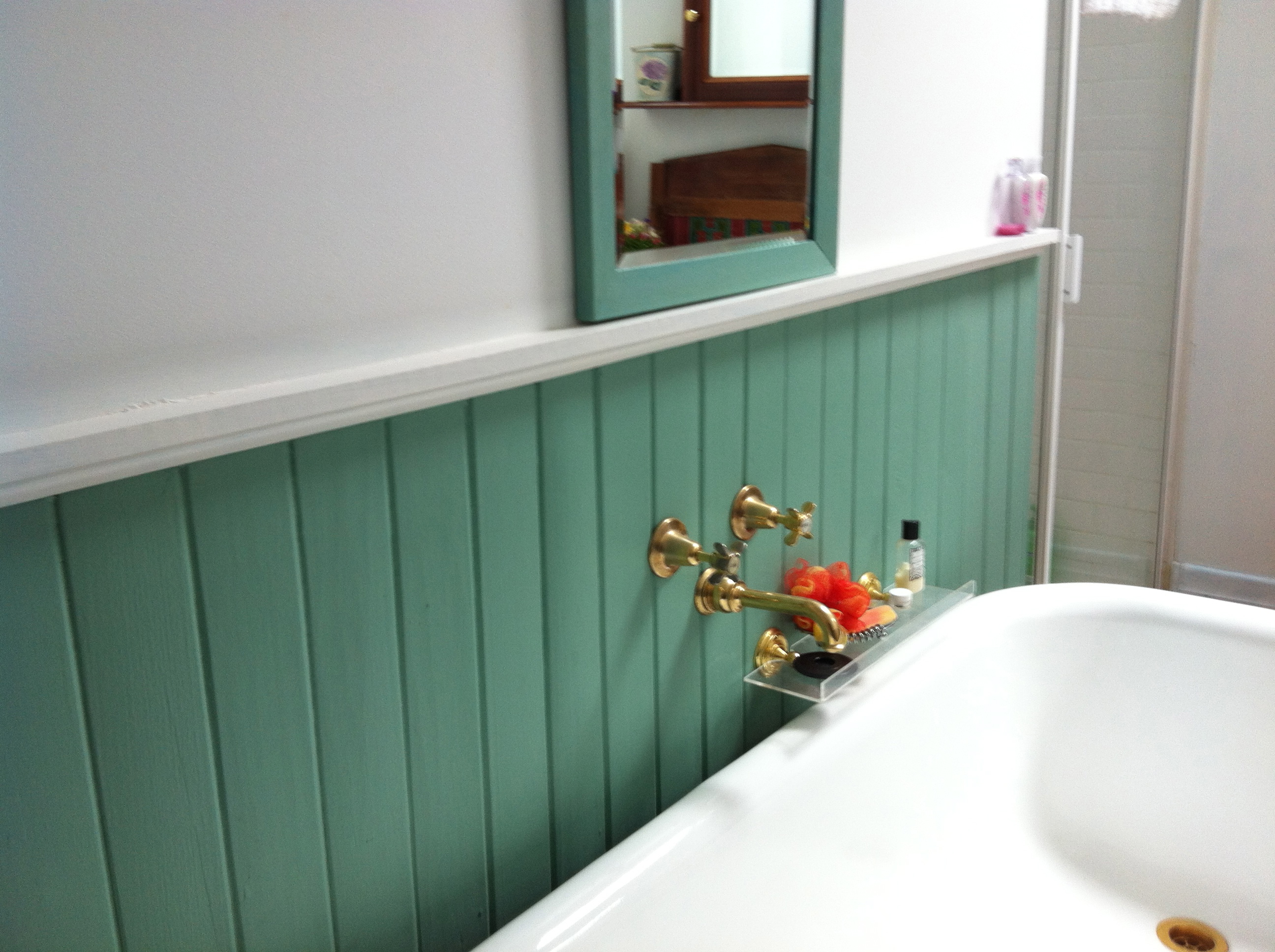
a bathroom renovation!
Why are we so keen on renovation? Is it an extension of ourselves as well as our houses? Or is it a way just to consume more and more? (And I do speak here as a seasoned renovator.) Do we really go to dinner parties and talk of bathroom tiles as Hugh Mackay suggested? Following fashions is not new; it can be seen in the Austen universe where the Eighteenth Century trend was to create the picturesque.
Upon taking over Norland, in Sense and Sensibility Fanny and John Dashwood, successful power couple, make it their daily business to be fashionable. On their estate, what looks good is the most important factor in a decision. Running a self-sufficient estate is not as important as impressing your friends and community. They must do improvements to the place and of course the productive “old walnut trees are all come down”. It reminds me of some people who move in to the old suburbs, raze the old garden getting rid of the roses and fruit trees, and replace the whole with shrubs and pebbles in the latest fashion. (Fortunately this is no longer the latest fashion!) And then they congratulate themselves on having destroyed a garden because now they are being water wise! No wonder Eleanor had to keep the “concern and her censure to herself” when she has to listen to her brother’s fashionable plans.
Filed under Living the Simple Life
Jane: in need of a ‘competence’

A money box, probably from last century. Without money and without the the means to make money, women were in a very precarious position.
Dear reader, as you may have noticed I find it annoying when I read in some sources that Jane Austen lived a sheltered life. It is as if we believe that women somehow were immune to the troubles that were going on around them. Surely it is more accurate to say that as women had no economic or political power they were in a much more precarious position; they had to learn to suffer in silence as their needs and wants were mostly unconsidered when the important decisions were being made. When we acquiesce and label women like Jane Austen as “sheltered”, it is as if we are buying into the propaganda of the times that by treating them as inconsequential we are really protecting and sheltering them. Continue reading
Filed under Money
Was Austen’s life sheltered?

English: Back View of Jane Austen, Watercolor (Photo credit: Wikipedia)
Often when reading excerpts about Austen’s life, there is a sense that Austen lived a sheltered life; that somehow she was immune to the difficulties of life. In reading about her life it is insightful to learn just how tricky Continue reading
Filed under Resilience
Managing the ordinary
If one could wave an Austenian wand and have a skill for life granted, it would be resilience. As Jane Austen described it in Persuasion, “It was the choicest gift from heaven”. Perhaps more than anything else, resilience is the ability that predicts a happy life. To be able to get back up after a fall, to be able to overcome a failure, to be able to move on after a disappointment – resilience is the value to covet.
Most of Austen’s heroines and heroes are just ordinary everyday people: they don’t think themselves Continue reading
Filed under Resilience
Madame Lefroy – Jane’s early mentor and friend

Signature of Jane Austen. Taken from her 1817 will. (Photo credit: Wikipedia)
Throughout Jane Austen’s life she developed close friendships with a number of women that survived her moving from Steventon in Hampshire, to Bath, Southampton and its surrounds, and then back to Hampshire to the little village of Chawton. These friendships endured despite quite an unsettled period in the middle of Jane’s life where she was in quite straightened circumstances. These friendships endured despite the fact that she held a very humble place in the society of her time; she was unmarried and poor. Both of these factors meant that no one would befriend her for an ulterior motive. Her friendships endured obviously because they must have embodied the principles that she so often wrote about.
It seems that Jane’s first significant friendship outside of her family was Continue reading
Filed under Friendship

 Austen's Guide to Happiness
