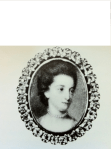
Jane’s birthday was yesterday and in her honour I ask: who was with Jane’s mother, when Jane was born? Interestingly it was her sister-in-law Philadelphia Austen Hancock, George Austen’s sister. From this we can assume that Phila, as she was called, was a well liked and trusted sister-in-law. George, Phila and Leonora were left orphaned and penniless but with family connections – their mother had been a baronet’s daughter. George used education as an avenue for advancement but this was not an option for Phila. Denied an education as a path to advancement she initially stayed living in London with an aunt. She had no dowry and so had to work for a living, hence she was apprenticed to a milliner in Covent Garden. It must have been a big step down for this baronet’s granddaughter. At that time, many milliner shops around Covent Garden were actually Continue reading
What have Dame Elisabeth and Jane Austen got in common?
Sometimes the modern dilemma may be that we cannot see outside ourselves and our own worries. Naturally our worries can take up an inordinate amount of time. Just this week I listened to a woman say that it is impossible to be focused on oneself if you think about others; when you are actively helping another, your own concerns seem to drift away. Is this why our very special Dame Elisabeth Murdoch, who passed away peacefully in her sleep this week, was so happy? Sure she had a fortunate life, but she chose to use her talents and her wealth to help others. She could have been jetsetting around the world partying with the hoi polloi but instead she dedicated her life to others and lived a quiet domestic country-style life that reminded me of the values that I have so enjoyed in the Austen Six. Did you hear the story that her cleaner, Queenie, was finding it hard to manage her duties for Dame Elisabeth? Continue reading
Filed under Resilience
Do women need to “have it all?” Or can happiness thrive without children?
Wendy Squires in The Age wrote an opinion piece, “Get a grip, girl, the reality is it’s time to stop sulking” (1/12/12). It amazes me that such an issue was relevant pre -feminism in Austen’s time as well. Are children essential for a happy life? Obviously not, as Jane Austen can attest, for she neither married nor had children. She was able to carve a life for herself that was rich in terms of family and children but did not involve herself as a mother or a wife. (And let’s not forget the literary genius role. ) The Austen Six always end with all Continue reading
What did Jane’s childhood look like?
What of Jane Austen herself? What sort of a childhood did she have? Can there be some interesting insight into this woman’s childhood that led her to be such a genius? My search seemed to be finding more truths as I began reading the very many biographies on Jane Austen. Obviously Jane’s life had held interest for many and since her death there have been an abundance of chronicles. Despite many suggesting not much is known about Austen, I was amazed just how much material there actually is about this one woman who lived over two hundred years ago and at the time of her death was anything but a celebrity.
Her first biographer, her nephew drew upon his and his family’s first-hand knowledge. I still remember the excitement I felt as I scanned Continue reading
Filed under Childhood
Is there a problem with being the ‘tiger mother’?
From Shakespeare’s Lady Macbeth to Austen’s Nightmare-Wife-Mrs Bennet from Pride and Prejudice, we see the pitfalls of ambition. Ambition for oneself is one thing but what about parents, who are ambitious for their children? Only recently the tiger mother has come into genesis but it is not a new concept. Is there something wrong with women or men who are wanting their children to fulfill a desire that they could not fulfill themselves, the father who wants his son to play cricket for Australia, England or India or the mother who wants her daughter to be Continue reading
Filed under Childhood
Should parents be a friend to their child?
Sometimes parents take the democratic values of equality between parents and children to such an extent that the roles can be reversed; the case of the parentified child shows the pitfalls of this. Should we allow the child to parent the parent? The child is often very independent and might even wake the parent or remind them of their jobs. Sometimes a child will play confidant to their parent’s troubles.
Often children can take on the parenting role when the actual parent has Continue reading
Filed under Childhood
Can we praise too much?
What an enduring truism, a way to a woman’s heart is through praise of her children. Why is it that when someone is quick to notice a particular gift in one of our offspring we feel a sense of warmth for that very person? Is it true that sometimes too much praise can set up an addiction in a child that is difficult to break?
Being able to distinguish between genuine praise and praise linked to an agenda is Continue reading
Filed under Childhood
Childhood in Austen’s World
What could Jane Austen possibly say about children that would have any relevance to today? As I struggle bringing up children in my very modern world, how could I rationally think of looking to Jane Austen to find some answers to my very modern dilemmas.She wrote of a world 200 years removed; a world of the rural village; a world without modern conveniences; a world where women were restricted to half a life. How different from me. I live in Australia, in a suburb just outside Melbourne, am a beneficiary of a university education, a job and a family. Yet, strangely I do find that she does have something to offer. I know I am just a little bit crazy but then all quests begin with a touch of madness!
Jane Austen was born in a little Hampshire village called Steventon, the seventh child of parents Cassandra and George. Continue reading
How could Jane Austen have anything to say to me?
Jane did live 200 years ago. She did write from a domestic point of view but within this she has much to say that can be generalised to us in the modern world. The interest in Jane Austen is now phenomenal for very good reason as she had much to say about children, family, romance and marriage, feminism or the woman’s question, money, resilience and living the everyday life.
Filed under Childhood, Family, Friendship, Resilience, Romance and Marriage


